
|
Text: |
Michael E. Fader |
|
Pictures: |
Urs Schnyder & Michael E. Fader |


(Picture courtesy Michael E. Fader)
(Picture courtesy Michael E. Fader)
Before
the flight programme begins, there is plenty of time to view the aircraft
parked in and in front of the hangars. One aircraft that caught the eye was
the Junkers A50 Junior. Founded in Switzerland in 2018, Junkers
Flugzeugwerke AG has begun reissuing the A50. Built according to old plans,
the model is a modern ultralight aircraft with an empty weight of 378 kg.
Externally, the new edition differs from its predecessor on the one hand in
its more aerodynamic nose (due to the absence of a radial engine) and on the
other hand in the use of a tail wheel instead of a skid. The wheels are
either covered with sheet metal discs, as in the original, or designed with
cross spokes.
Before the flight programme, you can also visit the Swiss Garden.
The Swiss Garden was laid out in the 1820s by Lord Ongley on a plot of land
next to his house, Old Warden Park. Ongley designed his garden in the then
fashionable “Swiss Picturesque” style. The extensive grounds, which were
originally a flat clay brick factory, were laid out to resemble the
foothills of the Alps and embellished with a series of buildings and
structures in various imaginative styles. The garden is the only complete
example of a Regency-style landscape in Britain and is therefore of great
historical importance. The Old Warden estate passed into the ownership of
Joseph Shuttleworth in the 1870s, who further expanded the Swiss garden and
added a grotto and artificial rock cascades.

Junkers A50 Junior (D-MQUI) (Picture courtesy Urs Schnyder)

Junkers A50 Junior (D-MQUI) (Picture courtesy Michael E. Fader)


(Picture courtesy Michael E. Fader)
(Picture courtesy Michael E. Fader)
(Picture courtesy Michael E. Fader)
(Picture courtesy Michael E. Fader)
(Picture courtesy Michael E. Fader)


(Picture courtesy Michael E. Fader)
(Picture courtesy Michael E. Fader)
(Picture courtesy Michael E. Fader)
(Picture courtesy Michael E. Fader)
(Picture courtesy Urs Schnyder)
Fighter
Fighters are the ultimate warbirds and one of the highlights at Old Warden. There was also something new in this category: the Chance-Vought F4U-5NL Corsair D-FCOR from Flying Legends GmbH was on display for the first time. The aircraft with the registration BuAer 124541 is one of the few whose deployment in Korea is documented. VMF-513 ‘Flying Nightmares’ of the U.S. Marines used it for night missions over the Korean Peninsula. The Corsair was then sold to Argentina and only brought to Le Castellet in France in 1994, where it underwent years of detailed restoration. In the course of this restoration, the F4U-5 was converted to the F4U-7 series to represent an Aeronavale aircraft. The F4U-7, F-AZYS, was flown by Ramon Josa. On 2. December 2009, MaxAlpha Aviation GmbH acquired the Corsair and moved it to its new home airport in Bremgarten. There it was given its current registration number, D-FCOR, after being converted back to F4U-5NL.
Two Spitfires were also among the fighters. The Spitfire with the registration G-BRRA is a Supermarine Spitfire Mk IX (MK912) that was built in 1944. It served in the Second World War and afterwards in various air forces, including the RAF, the Dutch and Belgian air forces, before ending up in a museum and then returning to the UK for extensive restoration. After completion, it flew again for the first time on 31 July 2024 and bears the livery of No. 312 (Czech) Squadron of the RAF.
Also painted in the colours of the RAF's No. 312 (Czech) Squadron was the Spitfire LF.Vc G-AWII, which was described in the first part.


Spitfire & Corsair (Picture courtesy Urs Schnyder)
Spitfire & Corsair (Picture courtesy Michael E. Fader)
Supermarine Spitfire LF.Vc (G-AWII) (Picture courtesy Urs Schnyder)
Supermarine Spitfire LF.Vc (G-AWII) (Picture courtesy Michael E. Fader)
Both Spitfires (Picture courtesy Urs Schnyder)


Both Spitfires (Picture courtesy Urs Schnyder)
Supermarine Spitfire Mk LFIXc (G-BRRA) (Picture courtesy Urs Schnyder)
Supermarine Spitfire Mk LFIXc (G-BRRA) (Picture courtesy Michael E. Fader)
Spitfire & Corsair (Picture courtesy Michael E. Fader)
Spitfire & Corsair (Picture courtesy Michael E. Fader)


Vought F4U-5NL Corsair (D-FCOR) (Picture courtesy Urs Schnyder)
Vought F4U-5NL Corsair (D-FCOR) (Picture courtesy Michael E. Fader)
Vought F4U-5NL Corsair (D-FCOR) (Picture courtesy Urs Schnyder)
Vought F4U-5NL Corsair (D-FCOR) (Picture courtesy Michael E. Fader)
Vought F4U-5NL Corsair (D-FCOR) (Picture courtesy Michael E. Fader)
L8032 was the last Gladiator built in 1937. In 1953, the Gladiator I was repurchased by Glosters, and in 1956 they decided to restore it to full military condition with the markings of No. 72 Squadron. When Gloster Aircraft closed, the Gladiator was handed over to the Shuttleworth Collection for safe keeping on 7 November 1960. In 1990, the aircraft was repainted in a camouflage scheme with the markings of No. 247 Squadron and carried these until it was re-covered with fabric in 1996. In 2007, it reappeared as K7985 of No. 73 Squadron of the RAF.
The Yakovlev Yak-3UWP F-AZIM is an aircraft equipped with a modern American Allison engine. Since the outbreak of the Ukraine conflict, former Russian registration numbers have been replaced by Ukrainian ones, although this aircraft was never used in this way.


Spitfire & Hurricane (Picture courtesy Urs Schnyder)
Gloster Gladiator I (G-AMRK.) (Picture courtesy Urs Schnyder)
Gloster Gladiator I (G-AMRK.) (Picture courtesy Urs Schnyder)
Yakovlev Yak-3UWP (F-AZIM) (Picture courtesy Michael E. Fader)
Yakovlev Yak-3UWP (F-AZIM) (Picture courtesy Michael E. Fader)
Douglas R4D-6S
We have already seen the Commemorative Air Force's N151ZE Douglas R4D-6S Skytrain at several air shows this year, so it's time to take a look at the history of this aircraft. Built in 1944 (Bu.Aer 50783), it is an R4D-6S, the U.S. Navy version of the DC-3 and C-47, and is now nicknamed "Ready-4-Duty".
Its first assignment was with VR-3, the Naval Air Transport Service, where it transported wounded soldiers and cargo/supplies until April 1946. It was then transferred to the Fleet Airborne Electronics Training Unit, Atlantic, and assigned to VX-1, an evaluation squadron based in Key West, Florida, where it evaluated top-secret electronic ‘gadgets’. Bu.Aer 50783 ended its career with the U.S. Navy in 1959 at Naval Air Reserve Training (NART), the training division of the U.S. Navy Reserve.
It later served with the U.S. Forestry Service before being taken over by the Commemorative Air Force (CAF). The claim made by the crew on an information board that the R4D-6S Skytrain was involved in the sinking of a submarine off Brazil cannot be confirmed. Nor is the current paint scheme of the aircraft known to have been used by the U.S. Navy's R4D.

(Picture courtesy Michael E. Fader)

(Picture courtesy Urs Schnyder)


(Picture courtesy Urs Schnyder)
(Picture courtesy Urs Schnyder)
(Picture courtesy Michael E. Fader)
(Picture courtesy Urs Schnyder)
(Picture courtesy Michael E. Fader)
Nieuport 23C-1
Swiss pilot Isidor von Arx was invited to participate in two air shows in Old Warden with his replica of a Nieuport 23C-1 from the world-famous Shuttleworth Collection. In order to perform in England, von Arx needs a British Display Authorisation. He passed the necessary evaluation flight in front of the specially invited examiner with flying colours on 12. May 2025 at Bleienbach Airfield.
On 21 October 2020, the Nieuport 23C-1 (HB-RNB) took off for the first time on a seven-minute flight in Grenchen. The aircraft was built according to plans drawn up by an engineer who was able to measure an original aircraft from the French manufacturer Nieuport in 1917.
This was one of the ‘firsts’ in Old Warden, as the Nieuport 23C-1 had never been seen in England before. Isidor von Arx skilfully flew the Nieuport 23C-1 in a way that would not have been possible in Switzerland, where different minimum altitudes apply, which are quite high. The fast turns he performed were proof that the Nieuport is extremely manoeuvrable. The aircraft is powered by a LeRhône 110 9Jb rotary engine. The entire engine is rigidly connected to the propeller, not just the crankshaft. This means that the entire nine-cylinder engine under the cowling rotates at several hundred revolutions per minute while the crankshaft remains stationary.


(Picture courtesy Urs Schnyder)
(Picture courtesy Urs Schnyder)
(Picture courtesy Michael E. Fader)
(Picture courtesy Michael E. Fader)
(Picture courtesy Michael E. Fader)


(Picture courtesy Urs Schnyder)
(Picture courtesy Michael E. Fader)
(Picture courtesy Michael E. Fader)
(Picture courtesy Urs Schnyder)
(Picture courtesy Michael E. Fader)
Between the Wars
The Desoutter Mk.I was a British sports aircraft produced by the Desoutter Aircraft Company at Croydon Aerodrome in Surrey. The aircraft is a licensed replica of the Koolhoven F.K.41, a Dutch three-seater cabin monoplane. However, the aircraft gained fame through its participation in the Victorian Centenary Air Race in 1934. Lt. M. Hansen and his co-pilot D. Jensen completed the route from Mildenhall, England, to Melbourne, Australia, in 129 hours and 47 minutes.
Airtime Aerobatics Ltd owns the de Havilland DH.83C Fox Moth G-ECDF – an extraordinary aircraft. Originally built in 1947 by De Havilland Canada as construction c/n FM50 and exported to New Zealand as ZK-AQM. In 2011, it was restored in the United Kingdom and initially registered under the identification G-CGUO; in March 2021, it received its current identification. Designer Arthur Ernest Hagg developed the Fox Moth in 1932 by combining the landing gear of the Tiger Moth with a new extended fuselage. The wings, tail, landing gear and engine mounts of the Tiger Moth remained unchanged, but the plywood fuselage was fitted with a closed cabin for four people between the engine and cockpit.

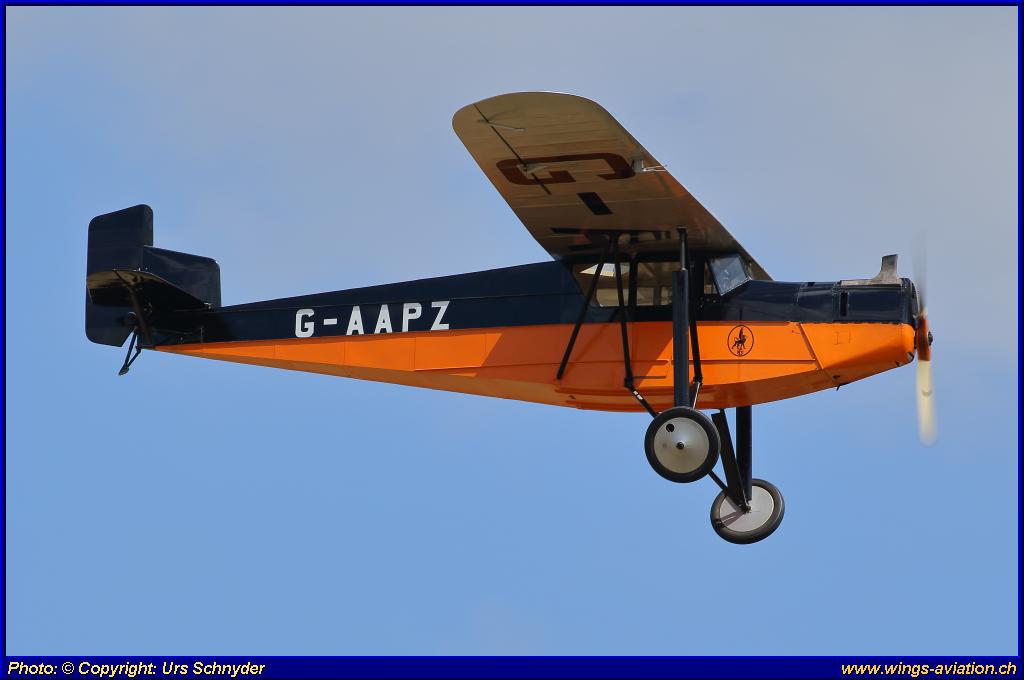


Desoutter Mk.I (G-AAPZ) (Picture courtesy Michael E. Fader)
Desoutter Mk.I (G-AAPZ) (Picture courtesy Urs Schnyder)
Desoutter Mk.I (G-AAPZ) (Picture courtesy Michael E. Fader)
Desoutter & DH.83 Fox Moth (Picture courtesy Urs Schnyder)
Desoutter & DH.83 Fox Moth (Picture courtesy Michael E. Fader)


Havilland DH.83C Fox Moth (G-ECDF) (Picture courtesy Michael E. Fader)
Havilland DH.83C Fox Moth ( G-ECDF) (Picture courtesy Urs Schnyder)
Havilland DH.83C Fox Moth (G-ECDF) (Picture courtesy Michael E. Fader)
Southern Martlet (G-AAYX) (Picture courtesy Urs Schnyder)
Parnall Elf II (G-AAIN) (Picture courtesy Urs Schnyder)
The de Havilland DH.88 Comet (G-ACSS), which was specially developed and built for the Victorian Centenary Air Race, an air race from Mildenhall, England to Melbourne, Australia, in 1934, is always a feast for the eyes. Grosvenor House is the name of the only aircraft still capable of flying. The de Havilland DH.88 Comet was displayed alongside the Miles Hawk Speed Six G-ADGP. This small racing aircraft was built on behalf of Luis Fontés for the 1935 King's Cup air race. Compared to the prototype, it had a larger V-shape and split rear edge flaps. It was powered by a 200 hp De Havilland Gipsy Six engine and completed in 1935. Unfortunately, it was unable to finish the race that year. Fontes flew it in races for several years and achieved some success.
The de Havilland DH.71 Tiger Moth, registered as G-ECOX, is a striking little monoplane. It was originally built in 1927 as an experimental racing and test aircraft.
The aircraft was built in 1932 and registered in India under the identification VT-ADO before being shipped to the province of Assam on behalf of its owner, Alban Ali. In 1933, Ali planned a flight from Calcutta to Heston, but on his way to England he took part in the Viceroy's air race. Ali flew the 700-mile route at an average speed of 124 mph, making him the second fastest of the day. He then continued his flight to England, but had to abandon it due to engine failure in Abu Sueir, Egypt. The aircraft had several owners before being acquired by the Shuttleworth Collection in 1996.


de Havilland DH.88 Comet (G-ACSS) (Picture courtesy Michael E. Fader)
de Havilland DH.88 Comet (G-ACSS) (Picture courtesy Michael E. Fader)
de Havilland DH.88 Comet (G-ACSS) (Picture courtesy Urs Schnyder)
de Havilland DH.88 Comet (G-ACSS) (Picture courtesy Urs Schnyder)
De Havilland DH.71 Tiger Moth (G-ECOX) (Picture courtesy Michael E. Fader)

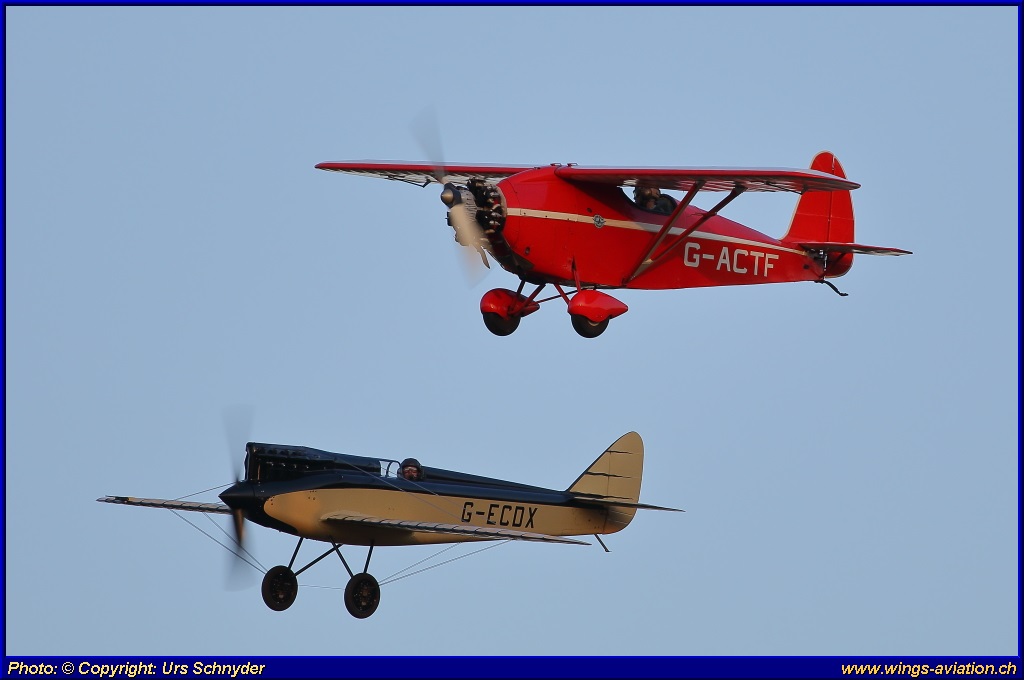


De Havilland DH.71 Tiger Moth (G-ECOX) (Picture courtesy Michael E. Fader)
De Havilland DH.71 & Comper Swift (Picture courtesy Urs Schnyder)
De Havilland DH.71 & Comper Swift (Picture courtesy Michael E. Fader)
De Havilland DH.71 & Comper Swift (Picture courtesy Urs Schnyder)
Comper Swift CLA-7 (G-ACTF) (Picture courtesy Urs Schnyder)


Comper Swift CLA-7 (G-ACTF) (Picture courtesy Michael E. Fader)
Miles Hawk Speed Six (G-ADGP) (Picture courtesy Michael E. Fader)
Miles Hawk Speed Six (G-ADGP) (Picture courtesy Urs Schnyder)
Miles Hawk Speed Six (G-ADGP) (Picture courtesy Urs Schnyder)
Miles Hawk Speed Six (G-ADGP) (Picture courtesy Michael E. Fader)
Transports
Two aircraft were displayed under Transport. The Avro Anson G-VROE, known as "Faithful Annie", is a T.21 built in 1950 by A V Roe and Company in Yeadon, West Yorkshire. It is one of the few examples of this type still airworthy today. The aircraft is part of the Classic Air Force Trust collection and participates in air shows in the UK and Europe. G-VROE was re-registered in 1998 and has since participated in numerous events, including a trip to Bahrain in 2000. It was restored by BAE Systems and donated to the Shuttleworth Collection in 2022.
The F-AZZR is a Dassault Aviation Flamant owned by the Pégase History organisation, which specialises in the preservation of historic aircraft. Pégase History is part of the Musée Européen de l'Aviation de Chasse in Montélimar. This aircraft was first seen at Old Warden. The two aircraft were shown flying together.


Avro Anson T-21 (G-VROE) (Picture courtesy Michael E. Fader)
Avro Anson T-21 (G-VROE) (Picture courtesy Urs Schnyder)
Avro Anson T-21 (G-VROE) (Picture courtesy Michael E. Fader)
Avro Anson & Dassault Flammant (Picture courtesy Urs Schnyder)
Avro Anson & Dassault Flammant (Picture courtesy Urs Schnyder)


Dassault MD-312 Flamant (F-AZZR) (Picture courtesy Michael E. Fader)
Dassault MD-312 Flamant (F-AZZR) (Picture courtesy Michael E. Fader)
Dassault MD-312 Flamant (F-AZZR) (Picture courtesy Michael E. Fader)
Blackburn Type D Single Seat Monoplane
Another ‘first’ was the Blackburn Type D Single Seat Monoplane, built by Robert Blackburn in Leeds in 1912. It was restored shortly after the Second World War and is now part of the Shuttleworth Collection and the oldest flying British aircraft. The aircraft is powered by a 50 hp Gnome rotary engine.
In 1914, pilot Montague Francis Glew crashed the aircraft. Due to the outbreak of the Great War, repairs were not possible. Richard Ormonde Shuttleworth discovered the aircraft in Wittering in 1938 and bought it. After the Second World War, the aircraft was restored by Shuttleworth's engineers. Almost everything on the restored aircraft was original, apart from the main wing spars, the engine cowling, a few minor wooden parts and the fabric covering.

(Picture courtesy Michael E. Fader)


(Picture courtesy Urs Schnyder)
(Picture courtesy Urs Schnyder)
(Picture courtesy Michael E. Fader)
(Picture courtesy Michael E. Fader)
(Picture courtesy Urs Schnyder)
English Electric Wren
The Wren, designed by W. O. Manning, was a light motor glider. Manning was a flying boat designer and decided to try his hand at a simpler project. The Wren was a single-engine high-wing monoplane with an empty weight of only 105 kg.
Interest in building very light aircraft was encouraged at the time by a £500 prize offered by the Duke of Sutherland. Participants had to build the most economical light single-seater aircraft. Another incentive was a £1,000 prize offered by the Daily Mail for the longest flight by a motor glider with an engine of no more than 750 cc. Two aircraft were built for the Lympne Light Aircraft Trials in October 1923. The Wren shared first prize with the ANEC I, which covered 140.8 km on one imperial gallon (4.5 litres) of fuel.


English Electric Wren (G-EBNV) (Picture courtesy Michael E. Fader)
English Electric Wren (G-EBNV) (Picture courtesy Michael E. Fader)
Edwardian
This name encompasses all aircraft that flew before the First World War, which was then referred to as the Great War. Of particular note is a Bleriot XI dating from 1909, which is the oldest aircraft in England. The aircraft's 3-cylinder engine is extremely weak, so it was not surprising that it only managed a hop of about 2 metres, just high enough for the pilot to record the flight in the logbook.
Also on display were the Bristol Boxkite and the Avro IV Triplane, which were made for the film ‘Those Magnificent Men in Their Flying Machines’ and are therefore replicas. As these two aircraft had modern engines, they also had considerably better flight characteristics. It was a pleasure to watch the pilots fly.


Bristol Boxkite (G-ASPP) (Picture courtesy Michael E. Fader)
Bristol Boxkite & Avro IV Triplane (Picture courtesy Michael E. Fader)
Avro IV Triplane (G-AHKX) (Picture courtesy Urs Schnyder)
Bristol Boxkite (G-ASPP) (Picture courtesy Michael E. Fader)


Bristol Boxkite & Avro IV Triplane (Picture courtesy Urs Schnyder)
Bristol Boxkite (G-ASPP) (Picture courtesy Michael E. Fader)
Bristol Boxkite (G-ASPP) (Picture courtesy Michael E. Fader)
Blériot XI (G-AANG) (Picture courtesy Michael E. Fader)
Overall, this air show was one of the best the editors had ever attended. It was very varied, with a wide range of aircraft on display covering the entire spectrum of aviation.


Bristol Boxkite (G-ASPP) (Picture courtesy Michael E. Fader)
Bristol Boxkite (G-ASPP) (Picture courtesy Michael E. Fader)
(Picture courtesy Michael E. Fader)
de Havilland DH.88 Comet (G-ACSS) (Picture courtesy Urs Schnyder)
Sunset at Old Warden (Picture courtesy Michael E. Fader)
