Helicopter Sea Combat Squadron 11
"Sub Seekers", "Dragonslayer"
|
History |
|
| 27. June 1957 | HS-11 Established at NAS Quonset Point RI |
| 1. June 2016 | HS-11 was redesignated HSC-11 |

|
Tailcodes |
|
| 1957 | HF |
| Planes: |
1958 - 1962
HSS-1
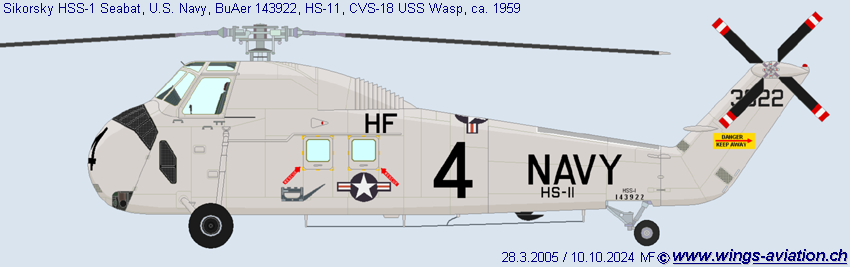
1962 - 1964
SH-34J
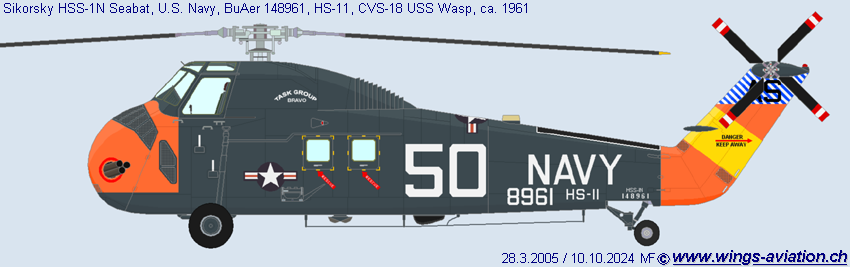
1964 - 1969
SH-3A


1969 - 1984
SH-3D


1984 - 1994
SH-3H
1994
- 20??
SH-60F
/ HH-60H
MH-60R
| HS-11, HSC-11 Deployments | ||||
| 31. January 1957 - 21. March 1957 | CVS-18 USS Wasp | - | HSS-1 | HF 00 |
| 6. April 1957 - June 1957 | CVS-18 USS Wasp | - | HSS-1 | HF 00 |
| 10. March 1958 - 29. April 1958 | CVS-18 USS Wasp | - | HSS-1 | HF 00 |
| 12. May 1958 - 15. October 1958 | CVS-18 USS Wasp | - | HSS-1 | HF 00 |
| 26. November 1958 - 13. December 1958 | CVS-18 USS Wasp | - | HSS-1 | HF 00 |
| May 1959 - July 1959 | CVS-18 USS Wasp | - | HSS-1 | HF 00 |
| August 1959 - October 1959 | CVS-18 USS Wasp | - | HSS-1 | HF 00 |
| December 1959 - January 1960 | CVS-18 USS Wasp | - | HSS-1 | HF 00 |
| 9. July 1960 - 25. August 1960 | CVS-18 USS Wasp | CVSG-52 | HSS-1, HSS-1N | AS 50 |
| 28. November 1960 - 8. December 1960 | CVS-18 USS Wasp | CVSG-52 | HSS-1, HSS-1N | AS 50 |
| 9. January 1961 - February 1961 | CVS-18 USS Wasp | CVSG-52 | HSS-1, HSS-1N | AS 50 |
| March 1961 - April 1961 | CVS-18 USS Wasp | CVSG-52 | HSS-1, HSS-1N | AS 50 |
| 9. June 1961 - 1. September 1961 | CVS-18 USS Wasp | CVSG-52 | HSS-1, HSS-1N | AS 50 |
| 11. January 1962 - 1. February 1962 | CVS-18 USS Wasp | CVSG-52 | HSS-1, HSS-1N | AS 50 |
| 18. February 1962 - 16. June 1962 | CVS-18 USS Wasp | CVSG-52 | HSS-1, HSS-1N | AS 50 |
| 2. November 1962 - 19. November 1962 | CVS-18 USS Wasp | CVSG-52 | HSS-1, HSS-1N | AS 50 |
| March 1963 - 4. April 1963 | CVS-18 USS Wasp | CVSG-52 | SH-3A | AS 50 |
| 14. May 1964 - 3. June 1964 | CVS-18 USS Wasp | CVSG-52 | SH-3A | AS 50 |
| 21. July 1964 - 7. August 1964 | CVS-18 USS Wasp | CVSG-52 | SH-3A | AS 50 |
| 8. September 1964 - 18. December 1964 | CVS-18 USS Wasp | CVSG-52 | SH-3A | AS 50 |
| 8. February 1965 - June 1965 | CVS-18 USS Wasp | CVSG-52 | SH-3A | AS 50 |
| December 1965 - 22. December 1965 | CVS-18 USS Wasp | CVSG-52 | SH-3A | AS 50 |
| 24. January 1966 - 18. February 1966 | CVS-18 USS Wasp | CVSG-52 | SH-3A | AS 50 |
| 18. April 1966 - 6. May 1966 | CVS-18 USS Wasp | CVSG-52 | SH-3A | AS 50 |
| 13. May 1966 - June 1966 | CVS-18 USS Wasp | CVSG-52 | SH-3A | AS 50 |
| 20. June 1966 - 1. July 1966 | CVS-18 USS Wasp | CVSG-52 | SH-3A | AS 50 |
| 25. July 1966 - 1. September 1966 | CVS-18 USS Wasp | CVSG-52 | SH-3A | AS 50 |
| 5. November 1966 - 18. November 1966 | CVS-18 USS Wasp | CVSG-52 | SH-3A | AS 50 |
| 28. November 1966 - 16. December 1966 | CVS-18 USS Wasp | CVSG-52 | SH-3A | AS 50 |
| 24. January 1967 - 26. February 1967 | CVS-18 USS Wasp | CVSG-52 | SH-3A | AS 50 |
| 19. March 1967 - 7. April 1967 | CVS-18 USS Wasp | CVSG-52 | SH-3A | AS 50 |
| 28. February 1968 - 6. April 1968 | CVS-18 USS Wasp | CVSG-52 | SH-3A | AS 50 |
| 29. April 1968 - 20. May 1968 | CVS-18 USS Wasp | CVSG-52 | SH-3A | AS 50 |
| 20. August 1968 - 19. December 1968 | CVS-18 USS Wasp | CVSG-52 | SH-3A | AS 50 |
| September 1969 - December 1969 | CVS-11 USS Intrepid | CVSG-52 | SH-3A | AS 50 |
| 2. December 1969 - 8. July 1970 | CVA-59 USS Forrestal | CVW-17 | SH-3D | AA 000 |
| Mar 1972 - 1972 | CVS-11 USS Intrepid | CVSG-56 | SH-3D | AU 440 |
| 11. July 1972 - 15. October 1972 | CVS-11 USS Intrepid | CVSG-56 | SH-3D | AU 440 |
| 24. November 1972 - 4. May 1973 | CVS-11 USS Intrepid | CVSG-56 | SH-3D | AU 440 |
| 28. June 1975 - 27. January 1976 | CV-67 USS John F. Kennedy | CVW-1 | SH-3D | AB 000 |
| 2. September 1976 - 9. November 1976 | CV-67 USS John F. Kennedy | CVW-1 | SH-3D | AB 000 |
| 15. January 1977 - 1. August 1977 | CV-67 USS John F. Kennedy | CVW-1 | SH-3D / H | AB 730 |
| 7. November 1977 - 13. December 1977 | CVN-69 USS Dwight D. Eisenhower | CVW-1 | SH-3D / H | AB 730 |
| 29. June 1978 - 8. February 1979 | CV-67 USS John F. Kennedy | CVW-1 | SH-3D / H | AB 730 |
| 4. August 1980 - 28. March 1981 | CV-67 USS John F. Kennedy | CVW-1 | SH-3D / H | AB 000 |
| 30. May 1982 - 8. July 1982 | CV-66 USS America | CVW-1 | SH-3D / H | AB 610 |
| 23. August 1982 - 30. October 1982 | CV-66 USS America | CVW-1 | SH-3D / H | AB 610 |
| 8. December 1982 - 2. June 1983 | CV-66 USS America | CVW-1 | SH-3D / H | AB 610 |
| 1. February 1984 - 21. February 1984 | CV-66 USS America | CVW-1 | SH-3H | AB 610 |
| 24. April 1984 - 14. November 1984 | CV-66 USS America | CVW-1 | SH-3H | AB 610 |
| 24. August 1985 - 9. October 1985 | CV-66 USS America | CVW-1 | SH-3H | AB 610 |
| 10. March 1986 - 10. September 1986 | CV-66 USS America | CVW-1 | SH-3H | AB 610 |
| 21. March 1988 - 6 May 1988 | CV-66 USS America | CVW-1 | SH-3H | AB 610 |
| 8. February 1989 - 3. April 1989 | CV-66 USS America | CVW-1 | SH-3H | AB 610 |
| 11. May 1989 - 10. November 1989 | CV-66 USS America | CVW-1 | SH-3H | AB 610 |
| 28. December 1990 - 18. April 1991 | CV-66 USS America | CVW-1 | SH-3H | AB 610 |
| 21. August 1991 - 11. October 1991 | CV-66 USS America | CVW-1 | SH-3H | AB 610 |
| 2. December 1991 - 6. June 1992 | CV-66 USS America | CVW-1 | SH-3H | AB 610 |
| 11. August 1993 - 5. February 1994 | CV-66 USS America | CVW-1 | SH-3H | AB 610 |
| 28. August 1995 - 24. February 1996 | CV-66 USS America | CVW-1 | SH-60F, HH-60H | AB 610 |
| 3. October 1997 - 3. April 1998 | CVN-73 USS George Washington | CVW-1 | SH-60F, HH-60H | AB 610 |
| August 1998 - September 1998 | CVN-75 USS Harry S. Truman | CVW-1 | SH-60F, HH-60H | AB 610 |
| 22. September 1999 - 19. March 2000 | CV-67 USS John F. Kennedy | CVW-1 | SH-60F, HH-60H | AB 610 |
| 19. September 2001 - 27. March 2002 | CVN-71 USS Theodore Roosevelt | CVW-1 | SH-60F, HH-60H | AB 610 |
| 28. August 2003 - 28. February 2004 | CVN-65 USS Enterprise | CVW-1 | SH-60F, HH-60H | AB 610 |
| 2. May 2006 - 18. November 2006 | CVN-65 USS Enterprise | CVW-1 | SH-60F, HH-60H | AB 610 |
| 7. July 2007 - 19. December 2007 | CVN-65 USS Enterprise | CVW-1 | SH-60F, HH-60H | AB 610 |
| 18. May 2009 - 30. May 2009 | CVN-77 USS George H.W. Bush | CVW-1 | SH-60F, HH-60H | AB 610 |
| 12. January 2010 - 31. January 2010 | CVN-70 USS Carl Vinson | CVW-17 | SH-60F, HH-60H | AB 610 |
| 13. January 2011 - 15. July 2011 | CVN-65 USS Enterprise | CVW-1 | SH-60F, HH-60H | AB 610 |
| 11. March 2012 - 4. November 2012 | CVN-65 USS Enterprise | CVW-1 | SH-60F, HH-60H | AB 610 |
| HS-11, HSC-11 Home Port Assignments | ||
| NAS Quonset Point RI | 27. Jun. 1957 | 17. Oct. 1973 |
| NAS Jacksonville FL. | 17. Oct. 1973 | 1. Jun. 2016 |
| NAS Norfolk VA. | 1. Jun. 2016 | present |
| HS-11, HSC-11 Commanding Officers | ||
| ? | ? | ? |
| Cdr. V. W. Collins | 1957 | ? |
| LCdr. G. I Dumas | Jul. 1958 | ? |
| ? | ? | ? |
| Pictures |


|
History |
|
Helicopter Antisubmarine
Squadron ELEVEN was established on 27. June 1957 at Naval Air Station
NAS Quonset Point, Rhode Island. The primary mission of the Seabat was
Antisubmarine Warfare (ASW) utilizing a dipping sonar. Later models of
the Seabat were upgraded with Doppler radar and automatic stabilization
and hover capabilities for all-weather operations. The HS-11 "Sub
Seekers" were assigned to CVSG-52 with the tail code AS and deployed
onboard USS Wasp CVS-18.
In December 1969, HS-11 became the first ASW helicopter squadron to deploy as part of a modern carrier air wing with CVW-17 onboard USS Forrestal CVA 59. From 1970-1973, HS-11 was assigned to CVSG-56 deploying onboard USS Intrepid CVS-11 with the tail code AU. On 17. October 1973, HS-11 moved to its new homeport of NAS Jacksonville and was re-assigned to CVW-1 where it remains assigned to this day. In 1976, the squadron was awarded the Navy Unit Commendation for saving countless lives after ship collisions at sea while attached to USS JOHN F KENNEDY. Over the years, HS-11 has the answered the domestic call for help numerous times in support of hurricane relief efforts, including Hurricane Andrew in 1993. In 1999, squadron SAR swimmers rescued nine men whose ship was sunk during Hurricane Floyd in winds over 50 knots and seas measuring 30 feet.
In 1989, HS-11 changed its
official call sign to Dragonslayers. HS-11 has made deployments onboard
USS John F. Kennedy CV-67, USS America CV-66, USS George Washington
CVN-73, USS Theodore Roosevelt CVN-71 and USS Enterprise CVN -65.
|
|
- Has anyone more Informations about this Squadron - |
