Breguet Atlantic
Aircraft of the German Marineflieger
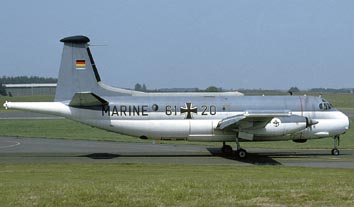
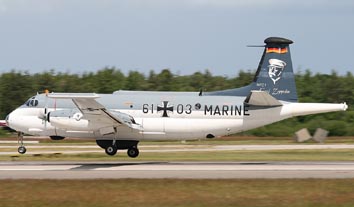
Entwicklung
The Breguet Br.1150 Atlantic
is a long-range maritime patrol aircraft designed and manufactured by
French aircraft manufacturer Breguet Aviation. Designed in response to a
1958 NATO speci-fication as a replacement for the Lockheed P2V- Neptune.
The Atlantic is a twin-engined, mid-winged monoplane with a "double-bubble"
fuselage; the upper lobe comprising a pressurised crew compartment, and
the lower lobe housing a 9 m long weapons bay, with sonobuoy tubes aft
of the weapons bay. A radar scanner is housed in a retractable
underfuselage radome, while a magnetic anomaly detector is housed in a
tail boom. It is powered by a pair of Rolls-Royce Tyne turboprop engines.
An initial order for 60 Atlantics – 40 for France and 20 for Germany –
was placed in 1963, with deliveries starting in 1965 and continuing to
1968. The production line had shut down by the time the Netherlands
placed an order for nine Atlantics and Italy ordered eighteen. Aircraft
from this second production batch were delivered from 1972 to 1974.
In 1978, the French Government authorised development of a new, updated
version of the Atlantic, the Atlantic Nouvelle Génération (later known
as the Atlantique 2). While the airframe and engines of the new aircraft
changed little, equipment and avionics were considerably revised; these
included new radar, a new sonar processor, a replacement tactical
computer, and a forward-looking infrared camera turret installed under
the nose.
Die Breguet Br.1150 Atlantic ist
ein Langstrecken-Seepatrouillenflugzeug, das vom französischen
Flugzeughersteller Breguet Aviation entwickelt und hergestellt wurde. Entwickelt als Reaktion
auf eine NATO-Spezifikation von 1958 als Ersatz für die Lockheed P2V-
Neptune. Die Atlantic ist ein zweimotoriger, mittelflügeliger Eindecker mit
einem "Doppelblasen"-Rumpf; das obere Deck umfasst den Mannschaftsraum als
Druckkabine und das untere Deck einen 9 m langen Waffenschacht mit
Sonobojenröhren hinter dem Waffenschacht. Ein Radarscanner ist in einem
einziehbaren Unter-rumpfradom, während ein magnetischer Anomalie-detektor in
einem Heckausleger untergebracht ist. Es wird von zwei Rolls-Royce Tyne
Turboprop-Triebwerken angetrieben.
Eine Erstbestellung über 60 Atlantic – 40 für Frankreich und 20 für
Deutschland – wurde 1963 aufgegeben, die Lieferungen begannen 1965 und
dauerten bis 1968. Die Produktionslinie war geschlossen, als die Niederlande neun Atlantics und
Italien achtzehn. Flugzeuge bestellte diese zweite Produktionscharge
wurden von 1972 bis 1974 ausgeliefert.
1978 genehmigte die französische Regierung die Entwicklung einer neuen,
aktualisierten Version des Atlantic, der Atlantic Nouvelle Génération
(später bekannt als Atlantique 2). Während sich die Flugzeugzelle und die
Triebwerke der neuen Flugzeuge kaum veränderten, wurden Ausrüstung und
Avionik erheblich überarbeitet; Dazu gehörten ein neues Radar, ein neuer
Sonarprozessor, ein taktischer Ersatzcomputer und ein Infrarot-Kameraturm,
der unter der Nase installiert wurde.
Versionen
BR 1150
Long-range maritime reconnaissance aircraft. 87 built
BR 1150
Seeaufklärer mit grosser Reichweite. 87 gebaut
Einsatzgeschichte
All 21 German Atlantic
aircraft were transferred to MFG-3, where they replaced the Gannet. When
the refit was almost complete, the squadron was given the traditional
name 'Graf Zeppelin' in July 1967.
In 1978, Dornier was entrusted with the implementation of a
comprehensive modernization programme (KWS) to increase the carcass
value and extend the service life. Modifications to the airframe and
improved corrosion protection. The result was the "Atlantic KWS" with
the more advanced, lowerable AN/APS-134 search radar; the more powerful
AN/AQA-5 Mod sonar data processing system; the wingtip-mounted EWI017A
ESM system, with which operators can detect, target and identify radar
signals and display them to the operating personnel; the new LN33
navigation system and a number of smaller improvements.
As part of a program with the code name 'Peace Peek', five aircraft were
converted and their regular operational equipment replaced by
comprehensive electronic espionage equipment. Used by the Federal
Intelligence Service for COMINT/SIGINT and ELINT.
Alle 21 deutschen Atlantic wurden
dem MFG-3 über-geben, wo sie die Gannet ablösten. Als die Umrüstung fast
abgeschlossen war, wurde dem Geschwader im Juli 1967 der Traditionsname
'Graf Zeppelin' verliehen.
Zur Steigerung des
Karnpfwertes und einer Verläng-erung der Lebensdauer, wurde Dornier 1978
mit der Durchführung eines umfassenden Modernisierung-sprogramms (KWS)
betraut. Modifizierungen der Zelle und ein verbesserter Korrosionsschutz. Es entstand die "Atlantic KWS" mit dem
fortschritt-licheren, absenkbaren Suchradar AN/APS-134; der leistungsgesteigerten Sonar-Datenverarbeitung-sanlage
AN/AQA-5 Mod,
flügelspitzeninstallierten ESM-System EWI017A, mit dem Bedienpersonal
Radarsignale entdeckt, angepeilt, identifiziert und dem Bedienpersonal
zur Anzeige gebracht werden können; der neuen Navigationsanlage LN33
sowie einer Vielzahl kleinerer Verbesserungen.
Im Rahmen eines Progranuns mit dem
Decknamen 'Peace Peek' wurden fünf Flugzeuge umgerüstet und ihre reguläre Einsatzausrüstung durch
umfas-sende elektronische Spionagegeräte ersetzt. Vom
Bundesnachrichtendienst für COMINT/SIGINT und ELINT
eingesetzt.
Zeichnungen
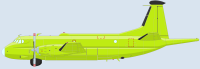
MFG-3
Bilder
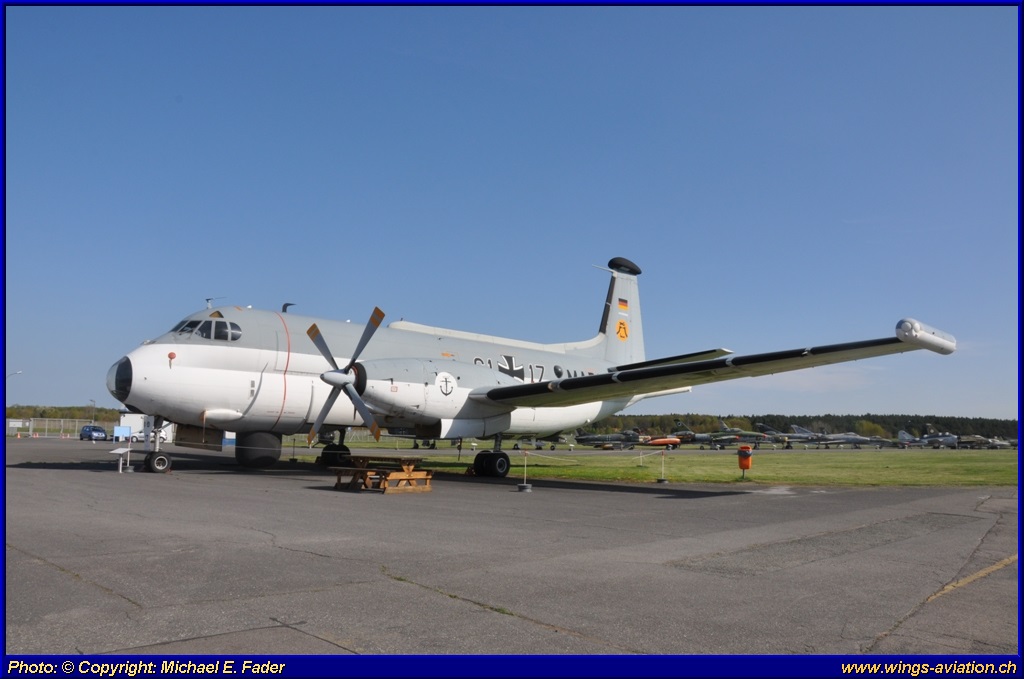
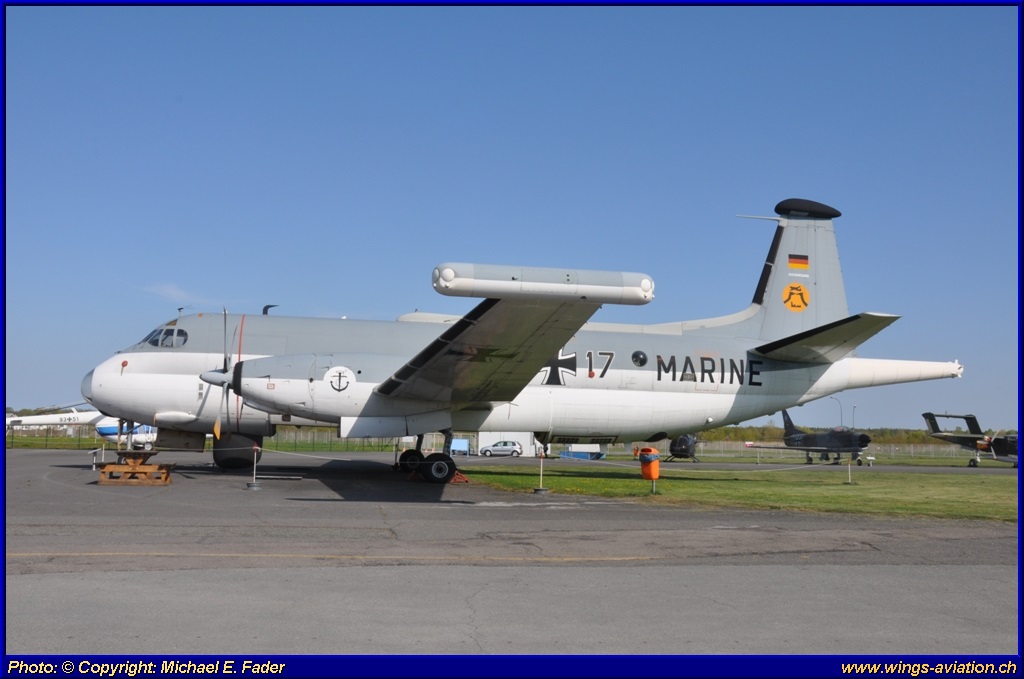
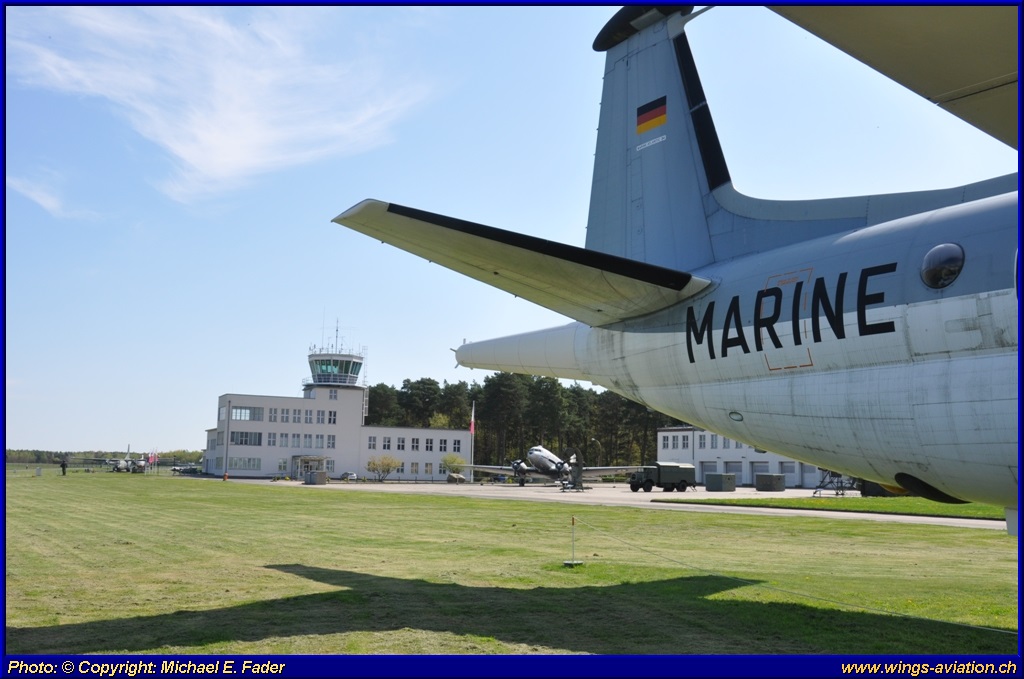
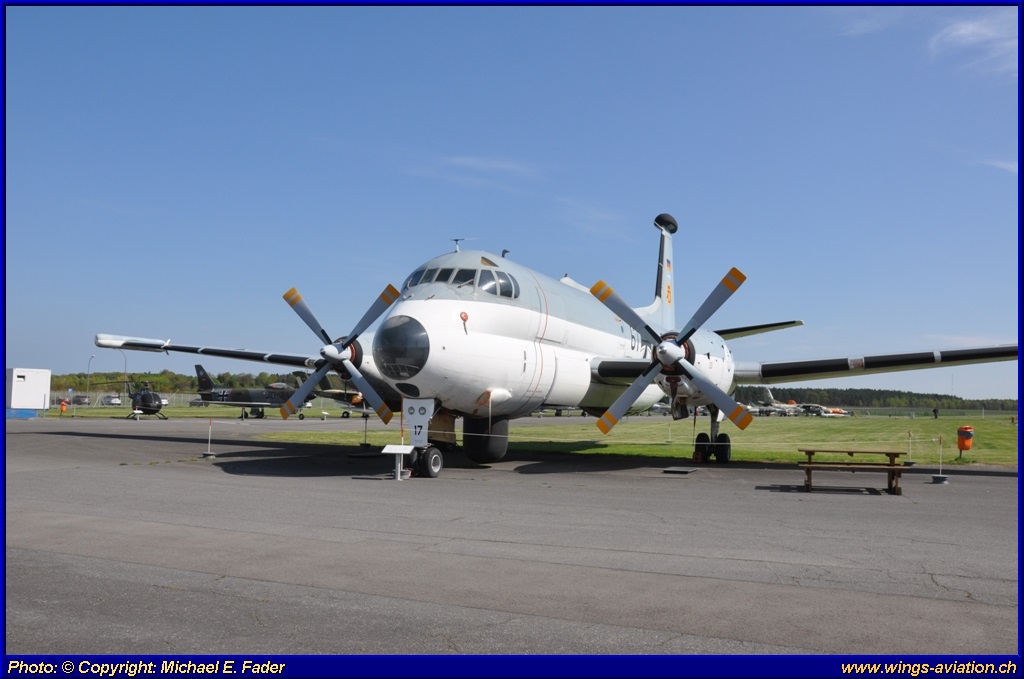
Breguet Atlantic 61+17 (Picture courtesy Michael E. Fader)
Breguet Atlantic 61+17 (Picture courtesy Michael E. Fader)
Breguet Atlantic 61+17 (Picture courtesy Michael E. Fader)
Breguet Atlantic 61+17 (Picture courtesy Michael E. Fader)
| Specifications | BR 1150 | |
|
Wingspan |
Spannweite |
37.42 m |
|
Length |
Länge |
31.62 m |
|
Height |
Höhe |
10.89 m |
|
Wing area |
Flügelfläche |
120.34 m² |
|
Engine |
Motor |
2× Rolls-Royce Tyne RTy.20 Mk 21 2-shaft turboprops, 6,100 ehp each |
|
Maximum speed |
Höchstgeschwindigkeit |
648 km/h |
|
Empty weight |
Leergewicht |
25,700 kg |
|
Loaded weight |
Startgewicht |
46,200 kg |
|
Climb Rate |
Steigrate |
14.7 m/s |
|
Service ceiling |
Gipfelhöhe |
9,145 m |
|
Range |
Reichweite |
9,075 km |
|
Armament |
Bewaffnung |
Up to 3,500 kg |
| Serial, Breguet Atlantic | |||||
| Typ | Buzz | s/n | Delivered | Withdrawn | Remarks |
| BR 1150 |
UC301 |
1 | ? | ? | - |
| BR 1150 | UC310, 61 + 01 | 2 | ? | ? | - |
| BR 1150 | UC311, 61 + 02 | 4 | ? | ? | Peace Peek version |
| BR 1150 | UC312, 61 + 03 | 6 | ? | ? | Peace Peek version |
| BR 1150 | UC313, 61 + 04 | 8 | ? | ? | - |
| BR 1150 | UC314, 61 + 05 | 10 | ? | ? | - |
| BR 1150 | UC315, 61 + 06 | 12 | ? | ? | Peace Peek version |
| BR 1150 | UC316, 61 + 07 | 14 | ? | 25. Apr. 1978 | - |
| BR 1150 | UC317, 61 + 08 | 16 | ? | ? | - |
| BR 1150 | UC318, 61 + 09 | 18 | ? | ? | - |
| BR 1150 | UC319, 61 + 10 | 20 | ? | ? | - |
| BR 1150 | UC320, 61 + 11 | 22 | ? | ? | - |
| BR 1150 | UC321, 61 + 12 | 24 | ? | ? | - |
| BR 1150 | UC322, 61 + 13 | 26 | ? | ? | - |
| BR 1150 | UC323, 61 + 14 | 28 | ? | ? | - |
| BR 1150 | UC324, 61 + 15 | 30 | ? | ? | - |
| BR 1150 | UC325, 61 + 16 | 32 | ? | ? | - |
| BR 1150 | UC326, 61 + 17 | 34 | ? | ? | - |
| BR 1150 | UC327, 61 + 18 | 36 | ? | ? | Peace Peek version |
| BR 1150 | 61 + 19 | 59 | 1970 | ? | Peace Peek version |
| BR 1150 | 61 + 20 | 60 | 1970 | ? | - |
|
Last update 8. December 2021 |
|||||
