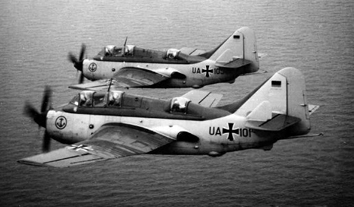
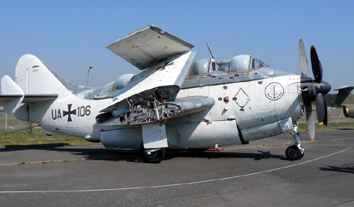
Development
Entwicklung
The Fairey Gannet is a
British carrier-borne aircraft of the post-Second World War era. It was
developed for the Royal Navy's Fleet Air Arm by the Fairey Aviation
Company. It was a mid-wing monoplane with a tricycle undercarriage and a
crew of three, with a double turboprop engine driving two
contra-rotating propellers. The Gannet was originally developed to meet
the FAA's dual-role anti-submarine warfare and strike requirement. It
was later adapted for operations as an electronic countermeasures and
carrier onboard delivery aircraft. The Gannet AEW.3 was a variant of the
aircraft developed as a carrier-based airborne early warning platform.
Fairey selected an engine based on the Armstrong Siddeley Mamba
turboprop: the Double Mamba, two Mambas mounted side-by-side and coupled
through a common gearbox to coaxial contra-rotating propellers. Each
engine drove its own propeller, and power was transmitted by a torsion
shaft which was engaged through a series gears to give a suitable
reduction ratio and correct propeller-shaft rotation..
Die Fairey Gannet ist ein
britisches Trägerflugzeug aus der Zeit nach dem Zweiten Weltkrieg. Es wurde
von der Fairey Aviation Company für den Fleet Air Arm der Royal Navy
entwickelt. Es war ein Mittelflügel-Eindecker mit einem Dreiradfahr-werk und
einer dreiköpfigen Besatzung, mit einem doppelten Turboprop-Motor, der zwei
gegenläufige Propeller antreibt. Das Gannet wurde ursprünglich entwickelt,
um die U-Boot-Abwehr- und Angriffs- anforderungen der FAA mit zwei Rollen zu
erfüllen. Es wurde später für den Betrieb als elektronische Gegenmassnahmen
und Träger Transportmaschine angepasst. Die Gannet AEW.3 war eine Variante
des Flugzeugs, das als trägergestützte Frühwarn-plattform in der Luft
entwickelt wurde.
Fairey entschied sich für einen Motor, der auf dem Armstrong Siddeley
Mamba-Turboprop basiert: den Double Mamba, zwei Mambas, die nebeneinander
montiert und über ein gemeinsames Getriebe mit koaxialen, gegenläufigen
Propellern gekoppelt sind. Jeder Motor trieb seinen eigenen Propeller an,
und die Kraft wurde von einer Torsionswelle übertragen, die durch eine Reihe
von Zahnrädern in Eingriff ge-bracht wurde, um ein geeignetes
Untersetzungs-verhältnis und eine korrekte Drehung der Propeller-welle zu
erzielen.
Variants
Versionen
AS.4
Improved Version of the AS.1 with the ASMD.4 engine with 3,875 hp and some equipment change, 75 converted
AS.4
Verbesserte Version des AS.1 mit dem ASMD.4 Triebwerk mit 3.875 PS und einigen Ausstattungsänderungen, 75 umgebaut
T.5
Dual Control Trainer version of AS.4, 3 converted from T.2 and 11 built
T.5
Operational history
Einsatzgeschichte
When the U-Stff was assigned the North Sea as its operational area in October 1961, it was administratively subordinated to MFG-2 (both MFGrp had already been granted squadron status in July 1959) and transferred to the new base in Westerland Sylt in 1962. On 26. April 1963, MFG-3 was established and temporarily stationed in Kiel-Holtenau until it could take over its final base in Nordholz. For the U-Stff, this meant another change in command structure. It was transferred to MFG-3 on 1. July 1964 and finally to Nordholz on 1. December 1964. Two years later, MFG-3 took over its first Bneguet "Atlantic" and began decom-missioning its Gannet.
Wie die Sea Hawk, war auch
die Gannet an Bord der britischen Flugzeugträger ein vertrauter Anblick.
Ihre Aufgabe war die U-Jagd. Die Bestellung der Bundesmarme
lautete über fünfzehn AS. Mk 4 und ein Schulflugzeug T.Mk 5 mit Doppelsteuerung für
den Fluglehrer. Beide Varianten waren bereits bei den britischen
Streitkräften eingeführt. Bereits am 20. Mai 1958 wurde die U-Jagdstaffel
(UStff) der MFGrp1 in RNAS Eglinton in Dienst gestellt. Ende Juli war die Ausbildung abgeschlossen und die Gannet wurden nach
Schleswig überführt. Gemeinsam mit den Sea Hawk der MFGrp1 wurden sie am
1. April 1958 einsatzbereit erklärt.
Als die U-Stff im Oktober
1961 die Nordsee als Einsatzraum zugewiesen erhielt, wurde sie
gleichzeitig administrativ dem MFG-2 (beide MFGrp hatten schon im Juli
1959 den Status von Geschwadern zuerkannt bekommen) unterstellt und 1962
auf den neuen Stützpunkt nach Westerland Sylt verlegt. Am 26. April
1963 wurde das MFG-3 aufgestellt und vorläufig in KielHoltenau
stationiert, bis es seinen endgültigen Stützpunkt Nordholz übernehmen
konnte. Für die U-Stff war dies mit einer erneuten Änderung der
Kommandostruktur verbunden. Sie wurde am 1. Juli 1964 MFG-3 und
schließlich am 1. Dezember 1964 nach Nordholz verlegt. Zwei Jahre später übernahm
MFG-3 seine erste Bneguet "Atlantic" und begann mit der Ausmusterung
ihrer Gannet.
Drawings
Zeichnungen
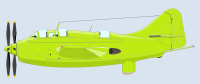
| Specifications |
AS.4 |
|
|
Wingspan |
Spannweite |
16.56 m |
|
Length |
Länge |
13.11 m |
|
Height |
Höhe |
4.19 m |
|
Wing area |
Flügelfläche |
44.90 m2 |
|
Engine |
Motor |
1 × Armstrong Siddeley ASMD.1 Double Mamba coupled turboprop engine, 2,950 shp |
|
Maximum speed |
Höchstgeschwindigkeit |
500 km/h |
|
Empty weight |
Leergewicht |
6,835 kg |
|
Loaded weight |
Startgewicht |
8,890 kg |
|
Climb Rate |
Steigrate |
? |
|
Service ceiling |
Gipfelhöhe |
7,600 m |
|
Range |
Reichweite |
1600 km |
|
Armament |
Bewaffnung |
Up to 2,000 lb of bombs, torpedoes, depth charges and rockets |
| Serial, Fairey Gannet | |||||
| Typ | Buzz | s/n | Delivered | Withdrawn | Remarks |
| AS-4 | UA101 | F9375 | 1958 | 1966 | - |
| AS-4 | UA102 | F9376 | 1958 | 1966 | - |
| AS-4 | UA103 | F9377 | 1958 | 1966 | - |
| AS-4 | UA104 | F9378 | 1958 | 1966 | - |
| AS-4 | UA105 | F9381 | 1958 | 1966 | - |
| AS-4 | UA106 | F9382 | 1958 | 1966 | - |
| AS-4 | UA107 | F9385 | 1958 | 1966 | - |
| AS-4 | UA108 | F9386 | 1958 | 1966 | - |
| AS-4 | UA109 | F9388 | 1958 | 1966 | - |
| AS-4 | UA110 | F9391 | 1958 | 1966 | - |
| AS-4 | UA111 | F9391 | 1958 | 1966 | - |
| AS-4 | UA112 | F9394 | 1958 | 1966 | - |
| AS-4 | UA113 | F9395 | 1958 | 1966 | - |
| AS-4 | UA114 | F9371 | 3. Nov. 1958 | 1966 | - |
| AS-4 | UA115 | F9372 | 3. Nov. 1958 | 12. Mai 1966 | w/o |
| T.5 | UA 99 | F9419 | 1958 | 1966 | - |
|
Last update 18. December 2020 |
|||||
