Westland Sea Lynx
Aircraft of the German Marineflieger
Entwicklung
The Westland Lynx is a
British multi-purpose twin-engined military helicopter designed and
built by Westland Helicopters at its factory in Yeovil. Originally
intended as a utility craft for both civil and naval usage, military
interest led to the development of both battlefield and naval variants.
The Lynx went into operational usage in 1977 and was later adopted by
the armed forces of over a dozen nations, primarily serving in the
battlefield utility, anti-armour, search and rescue and anti-submarine
warfare roles.
The initial design, then known as the Westland WG.13, was started in the
mid-1960s as a replacement for the Westland Scout and Wasp, and a more
advanced alternative to the UH-1 Iroquois. The design was to be powered
by a pair of Bristol Siddeley BS.360 turboshaft engines. As part of the
Anglo-French helicopter agreement signed in February 1967, French
company Sud Aviation (later Aérospatiale) had a 30 per cent share of
production work, Westland performing the remainder. It was intended that
France would procure the Lynx for its Navy. The first Lynx prototype
took its maiden flight on 21. March 1971.
Die Westland Lynx ist ein
britischer zweimotoriger Mehrzweck-Militärhubschrauber, der von Westland
Helicopters in seinem Werk in Yeovil entwickelt und gebaut wird.
Ursprünglich als Nutzfahrzeug für die zivile und maritime Nutzung gedacht,
führte das militärische Interesse zur Entwicklung sowohl von Kampf- als auch
von Marinevarianten. Der Lynx wurde 1977 in Dienst gestellt und später von
den Streitkräften von mehr als einem Dutzend Nationen übernommen, wobei er
in erster Linie als Kampf-hubschrauber, Panzerabwehrhubschrauber, Such- und
Rettungshubschrauber und zur U-Boot-Bekämpfung eingesetzt wurde.)
Der ursprüngliche Entwurf, der damals als Westland WG.13 bekannt war, wurde
Mitte der 1960er Jahre als Ersatz für den Westland Scout und den Wasp und
als fortschrittlichere Alternative zum UH-1 Iroquois begonnen. Der Entwurf
sollte von zwei Bristol Siddeley BS.360-Turbomotoren angetrieben werden. Im
Rahmen des im Februar 1967 unterzeichneten anglo-französischen
Hub-schrauberabkommens hatte das französische Unternehmen Sud Aviation
(später Aérospatiale) einen Anteil von 30 Prozent an der Produktion, während
Westland den Rest übernahm. Es war vorgesehen, dass Frankreich den Lynx für
seine Marine beschaffen würde. Der erste Lynx-Prototyp absolvierte am 21.
März 1971 seinen Jungfernflug.
Versionen
Mk. 88
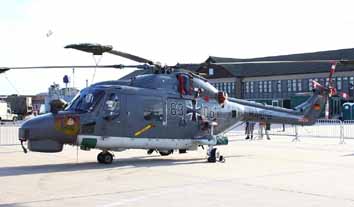
Export version for the German Navy with Gem 42 engines, and dipping sonar. 19 built.
Mk. 88
Exportversion für die deutsche Marine mit Gem 42-Motoren und Tauchsonar. 19 Stück gebaut.
Mk. 88A
Upgraded export version for the German Navy with Gem 42 engines, under-nose radome with 360° traverse radar and FLIR above nose. Seven new build helicopters plus conversion of 17 Mk.88s.
Mk. 88A
Aufgerüstete Exportversion für die Deutsche Marine mit Gem 42-Motoren, Radom unter der Nase mit 360°-Traverse-Radar und FLIR über der Nase. Sieben neu gebaute Hubschrauber sowie Umbau von 17 Mk.88.
Einsatzgeschichte
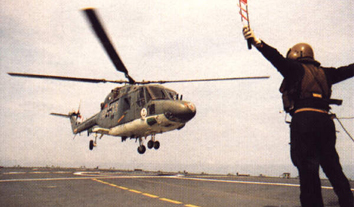
Among NATO's naval forces, the German Navy was the last to begin using ship-based helicopters. The prerequisite for this completely new type of operation for German naval aviation was the commissioning of the new Class 122 multi-purpose frigates in 1982. Each of these frigates has a landing platform and a hangar for two helicopters. The naval aviators found a suitable on-board helicopter in the Lynx Mk 88; twelve were ordered by 1983. When the decision was later made to build additional Class 122 frigates, this inevitably involved the procurement of further Lynxs. The naval aviators received two new Lynx in 1984 and five in January 1986.
Unter den Seestreitkräften der NATO begann die Bundesmarine als letzte mit dem Einsatz schiffs-gestützter Hubschrauber. Voraussetzung für diese gänzlich neue Einsatzart der deutschen Marine-flieger war die Indienststellung der neuen Mehrzweckfregatten der Klasse 122 im Jahre 1982. Jede dieser Fregatten besitzt eine Landeplattform sowie einen Hangar für zwei Hubschrauber. Den geeigneten Bordhubschrauber fanden die Marineflieger im Lynx Mk 88; bis 1983 wurden zwölf bestellt. Als später der Bau zusätzlicher Fregatten der Klasse 122 beschlossen wurde, war damit zwangsläufig auch die Beschaffung weiterer Lynx verbunden. So erhielten die Marineflieger 1984 zwei und im Januar 1986 fünf neue Lynx.
Zeichnungen
MFG-3
Technische Daten
| Specifications | Lynx | |
|
Rotor diameter |
Rotordurchmesser |
15,40 m |
|
Length |
Länge |
12,33 m |
|
Height |
Höhe |
3,60 m |
|
Engine |
Motor |
2 x Rolls Royce Gem 41 1,120 PS each |
|
Maximum speed |
Höchstgeschwindigkeit |
330 km/h |
|
Empty weight |
Leergewicht |
3,291 kg |
|
Loaded weight |
Startgewicht |
5,330 kg |
|
Climb Rate |
Steigrate |
600 m/min |
|
Service ceiling |
Gipfelhöhe |
? |
|
Range |
Reichweite |
885 km |
|
Armament |
Bewaffnung |
2 x torpedoes |
Seriennummern
| Westland Sea Lynx | |||||
| Type | s/n | Buzz | Delivered | Withdrawn | - |
| Mk 88 | ? | 83 + 01 | Juni 1981 | ? | - |
| Mk 88 | ? | 83 + 02 | 1981 | ? | - |
| Mk 88 | ? | 83 + 03 | 1981 | ? | - |
| Mk 88 | ? | 83 + 04 | 1981 | ? | - |
| Mk 88 | ? | 83 + 05 | 1981 | ? | - |
| Mk 88 | ? | 83 + 06 | ? | ? | - |
| Mk 88 | ? | 83 + 07 | ? | ? | - |
| Mk 88 | ? | 83 + 08 | ? | ? | - |
| Mk 88 | ? | 83 + 09 | ? | ? | - |
| Mk 88 | ? | 83 + 10 | ? | ? | - |
| Mk 88 | ? | 83 + 11 | ? | ? | - |
| Mk 88 | ? | 83 + 12 | 1983 | ? | - |
| Mk 88 | ? | 83 + 13 | Oct. 1986 | ? | - |
| Mk 88 | ? | 83 + 14 | Nov 1986 | ? | - |
| Mk 88 | ? | 83 + 15 | Jan. 1986 | ? | - |
| Mk 88 | ? | 83 + 16 | Jan. 1986 | ? | - |
| Mk 88 | ? | 83 + 17 | Jan. 1986 | ? | - |
| Mk 88 | ? | 83 + 18 | Jan. 1986 | ? | - |
| Mk 88 | ? | 83 + 19 | Jan. 1986 | ? | - |
