Westland Seaking
Aircraft of the German Marineflieger
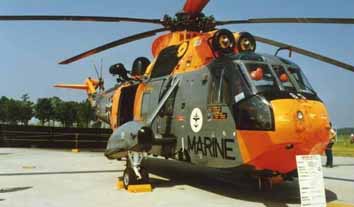
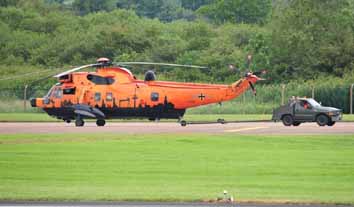
Entwicklung
The Westland WS-61 Sea King
is a British licence-built version of the American Sikorsky S-61
helicopter of the same name, built by Westland Helicopters. The aircraft
differs considerably from the American version, with Rolls-Royce Gnome
engines (derived from the US General Electric T58), British-made
anti-submarine warfare systems and a fully computerised flight control
system. The Sea King was primarily designed for performing
anti-submarine warfare (ASW) missions. A Sea King variant known as the
Commando was devised by Westland to serve as a troop transport.
In British service, the Westland Sea King provided a wide range of
services in both the Royal Navy and the Royal Air Force. As well as
wartime roles in the Falklands War, the Gulf War, the Bosnian War, the
Iraq War and the Afghanistan War, the Sea King is perhaps most well
known in its capacity as a Royal Navy and RAF Search and Rescue Force
helicopter. The Sea King was also adapted to meet the Royal Navy's
requirement for a ship-based airborne early warning platform.
On 26. September 2018, the last remaining Sea King variant in Royal Navy
service was retired.
Die Westland WS-61 Sea King ist
eine in britischer Lizenz gebaute Version des gleichnamigen amerikanischen
Hubschraubers Sikorsky S-61, ge-baut von Westland Helicopters. Das Flugzeug
unterscheidet sich erheblich von der amerika-nischen Version mit Rolls-Royce
Gnome-Trieb-werken (abgeleitet vom US General Electric T58), in
Grossbritannien hergestellten U-Boot-Abwehr-systemen und einem vollständig
computer-isierten Flugsteuerungssystem. Die Sea King wurde in erster Linie
für die Durchführung von Missionen zur U-Boot-Bekämpfung (ASW) ent-wickelt.
Eine als Commando bekannte Sea King-Variante wurde von Westland entwickelt,
um als Truppentransporter zu dienen.
Im britischen Dienst leistete die Westland Sea King sowohl in der Royal Navy
als auch in der Royal Air Force eine breite Palette von Diensten. Neben
Kriegseinsätzen im Falklandkrieg, Golfkrieg, Bosnien-krieg, Irakkrieg und
Afghanistankrieg ist die Sea King vielleicht am bekanntesten in ihrer
Eigenschaft als Hub-schrauber der Royal Navy und der RAF Search and Rescue
Force. Die Sea King wurde auch angepasst, um die Anforderungen der Royal
Navy nach einer schiffsgestützten Frühwarn-plattform in der Luft zu
erfüllen.
Am 26. September 2018 wurde die letzte verbleibende Sea King-Variante im
Dienst der Royal Navy ausgemustert.
Versionen
Mk. 41
Search and rescue version of the Sea King HAS.1 for the German Navy, with longer cabin; 23 built.
Mk. 41
Such- und Rettungsversion des Sea King HAS.1 für die Deutsche Marine, mit längerer Kabine; 23 Stück gebaut.
Einsatzgeschichte
The German Navy placed an
order for 22 Sea King Mk.41s on 20 June 1969 as a replacement for the
Grumman Albatross flying boat in the Search and Rescue Role. This was
the first export sale for the Westland Sea King, and was the first
dedicated Search and Rescue Sea King variant, with an enlarged cabin and
more fuel. The German Sea Kings had similar radar and navigation
equipment to the HAS.1, but was not fitted with sonar. The 22 Sea Kings
were delivered between April 1973 and September 1974, equipping
Marinefliegergeschwa-der 5 (MFG 5). An additional Sea King was delivered
in April 1975 to replace one destroyed in a gale. The surviving Sea
Kings were upgraded between 1986 and 1988, adding the capability to
carry Sea Skua anti-ship missiles, which required the addition of a
Ferranti Seaspray radar in a nose radome.
The 21 remaining Sea Kings are tasked to a variety of roles including
SAR, transport, disaster relief, tactical land–sea transport, evacuation,
surveil-lance, reconnaissance and naval support. The main base is
Nordholz, although units are always stationed at Heligoland Airfield and
Warnemünde, and sometimes at Borkum Airfield. The helicopters are
scheduled to be replaced by the NH-90.
Die deutsche
Marine bestellte am 20. Juni 1969 22 Sea King Mk.41 als Ersatz für das
Grumman Albatross-Flugboot in der Such- und Rettungsrolle. Dies war der
erste Exportverkauf für die Westland Sea King und die erste spezielle Sea
King-Variante für Such- und Rettungseinsätze mit einer vergrößerten Kabine
und mehr Treibstoff. Die deutschen Sea Kings hatten eine ähnliche Radar- und
Navigationsausrüstung wie die HAS.1, waren aber nicht mit Sonar
ausgestattet. Die 22 Sea Kings wurden zwischen April 1973 und September 1974
für das Marinefliegergeschwader 5 (MFG 5) ausgeliefert. Eine weitere Sea
King wurde im April 1975 als Ersatz für eine in einem Sturm zerstörte Sea
King ausgeliefert. Die überlebenden Sea Kings wurden zwischen 1986 und 1988
aufgerüstet und erhielten die Fähigkeit, Sea Skua-Schiffsabwehr-raketen zu
tragen, was den Einbau eines Ferranti Seaspray-Radars in das Bugradom
erforderte.
Die 21 verbleibenden Sea Kings werden für eine Vielzahl von Aufgaben
eingesetzt, darunter SAR, Transport, Katastrophenhilfe, taktischer
Land-See-Transport, Evakuierung, Überwachung, Aufklärung und Unterstützung
der Marine. Der Hauptstützpunkt ist Nordholz, obwohl die Einheiten immer auf
dem Flugplatz Helgoland und Warnemünde und manchmal auf dem Flugplatz Borkum
stationiert sind. Die Hubschrauber sollen durch den NH-90 ersetzt werden.
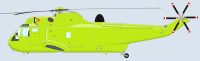
Zeichnungen
MSnStff
Technische Daten
| Specifications |
Mk. 41 |
|
|
Rotor diameter |
Rotordurchmesser |
18.90 m |
|
Length |
Länge |
17.02 m |
|
Height |
Höhe |
5.13 m |
|
Engine |
Motor |
2 × Rolls-Royce Gnome H1400-2 turboshafts, 1,660 shp each |
|
Maximum speed |
Höchstgeschwindigkeit |
208 km/h |
|
Empty weight |
Leergewicht |
6,387 kg |
|
Loaded weight |
Startgewicht |
9,525 kg |
|
Climb Rate |
Steigrate |
10.3 m/s |
|
Service ceiling |
Gipfelhöhe |
3,050 m |
|
Range |
Reichweite |
1,230 km |
|
Armament |
Bewaffnung |
4× torpedos, or 4× Depth charges |
Seriennummern
| Serial, Westland Sea King | |||||
| Typ | Buzz | s/n | Delivered | Withdrawn | Remarks |
|
Last update 8. December 2021 |
|||||
