

|
Text: |
Michael E. Fader |
|
Pictures: |
Michael E. Fader |


(Picture courtesy Messe FriedrichshafenGmbH.)
(Picture courtesy Messe FriedrichshafenGmbH.)
Around 860 exhibitors from 50 countries are taking part in this year’s AERO exhibition in Friedrichshafen from 22. to 25. April 2026. Wings-Aviation was able to get a first-hand look at the exhibition even before it opened; as Tobias Bretzel, AERO Project Manager, said, it is the leading global trade fair for general aviation, business aviation and air sports.
AERO is dedicated to general aviation, business aviation and air sports. Aircraft on display range from civil drones, ultralights and gyrocopters to helicopters, passenger and training aircraft with piston or turboprop engines, right through to business jets. New propulsion systems, electric flight, state-of-the-art avionics, services and accessories for pilots are further key areas. These topics are also reflected in the AERO Conferences, making Europe’s largest general aviation event an important platform for knowledge exchange and professional development.
Intro
In a panel discussion chaired by Cate Brancart (Director of European Safety & Sustainability Development at the General Aviation Manufacturers Association) with Svenja Wortmann (Managing Director of the business aviation company DC Aviation Group), Daniel Günter (COO of Flight Design), Katrin Mayrhofer (COO and co-founder of drone manufacturer ELSA Industry) and Tobias Bretzel (AERO project manager at Fairnamic GmbH), the future of aviation was discussed.
-
Svenja Wortmann emphasised that general aviation is not a luxury but offers significant benefits. This is particularly true in the fields of air rescue, training, firefighting and transport. Innovations are implemented quickly, and the industry is setting the pace in the field of electric propulsion systems for aircraft.
-
Katrin Mayrhofer emphasised that hydrogen propulsion is being developed for aircraft and represents the future. On the other hand, there was criticism of the overly restrictive regulatory framework, which hinders innovation and stifles investment, particularly in Germany.
-
In another point of discussion, Katrin Mayrhofer pointed out that training for ‘blue-collar’ mechanics is sometimes lacking, meaning there is a shortage of available workers. She also criticised the poor standing of this occupational group compared to academic professions, which makes it difficult to recruit new staff.
-
In general, there have been calls for drones to be integrated into airspace surveillance, as this sector of aviation is experiencing exponential growth and the existing regulations – that is, the rather unregulated approach – are no longer effective.


(Picture courtesy Michael E. Fader)
(Picture courtesy Michael E. Fader)
(Picture courtesy Michael E. Fader)
(Picture courtesy Michael E. Fader)
(Picture courtesy Michael E. Fader)
Impressionen
Last year, over 4,150 aircraft (including helicopters) from the general aviation and business aviation sectors were delivered to customers worldwide. The industry has started 2026 with strong momentum. Total industry revenue exceeded the US$35 billion mark in 2025.
Wings-Aviation focuses on some of the highlights and news from this year’s trade fair.


Hubschrauber der Bundeswehr (Heer), NH-90, Bo-105 uns Sikorsky Sea Stallion (Picture courtesy Michael E. Fader)
Tecnam P212 (Picture courtesy Michael E. Fader)
Learjet 60XR (Picture courtesy Michael E. Fader)


Piaggo P.180 Avanti (Picture courtesy Michael E. Fader)
Piaggo P.180 Avanti (Picture courtesy Michael E. Fader)
Piaggo P.180 Avanti (Picture courtesy Michael E. Fader)
Black Shape Aircraft Prime (Picture courtesy Michael E. Fader)
Black Shape Aircraft Prime (Picture courtesy Michael E. Fader)


Aerospool WT-9 Dynamic(Picture courtesy Michael E. Fader)
Diamond DA50RG (Picture courtesy Michael E. Fader)
Diamond DA-42NG Twin Star (Picture courtesy Michael E. Fader)
BRM Aero Bristell B23-916 (Picture courtesy Michael E. Fader)
Cessna 172S Skyhawk (Picture courtesy Michael E. Fader)


Cessna 208 Caravan (Picture courtesy Michael E. Fader)
Cessna 208 Caravan (Picture courtesy Michael E. Fader)
Cessna Skycourier (Picture courtesy Michael E. Fader)
Cessna Skycourier (Picture courtesy Michael E. Fader)
Cessna Citation Ascendent (Picture courtesy Michael E. Fader)
Volocopter & EVOcopter
A truly innovative concept is the Volocopter, which made its maiden flight on 17. November 2013. It is a type of helicopter with 18 electric motors that looks like an oversized quadcopter. The control system requires no mechanical components and operates solely by reducing or increasing the power of individual motors. The range or flight duration is approximately 1 hour. This concept was unveiled for the first time at AERO 2014. To date, no units have been sold and the aircraft have not yet been certified.
The Classix from EVOcopter, which was certified in 2025 and is now on sale, has come much further and been developed in a much shorter timeframe of just five years. The Classix is, as the name suggests, a conventional light helicopter in the same class as the Robin R-22. The aircraft is powered by a classic Lycoming O-360J2A boxer engine. The airframe is constructed entirely from carbon fibre. The Lycoming O-360J2A engine, with a displacement of 6 litres, is an advantage for the helicopter, as spare parts and servicing for this engine are available worldwide. The biggest drawback, however, was the engine’s relatively high weight compared to the helicopter’s lightweight construction, as Paul Reessle pointed out.

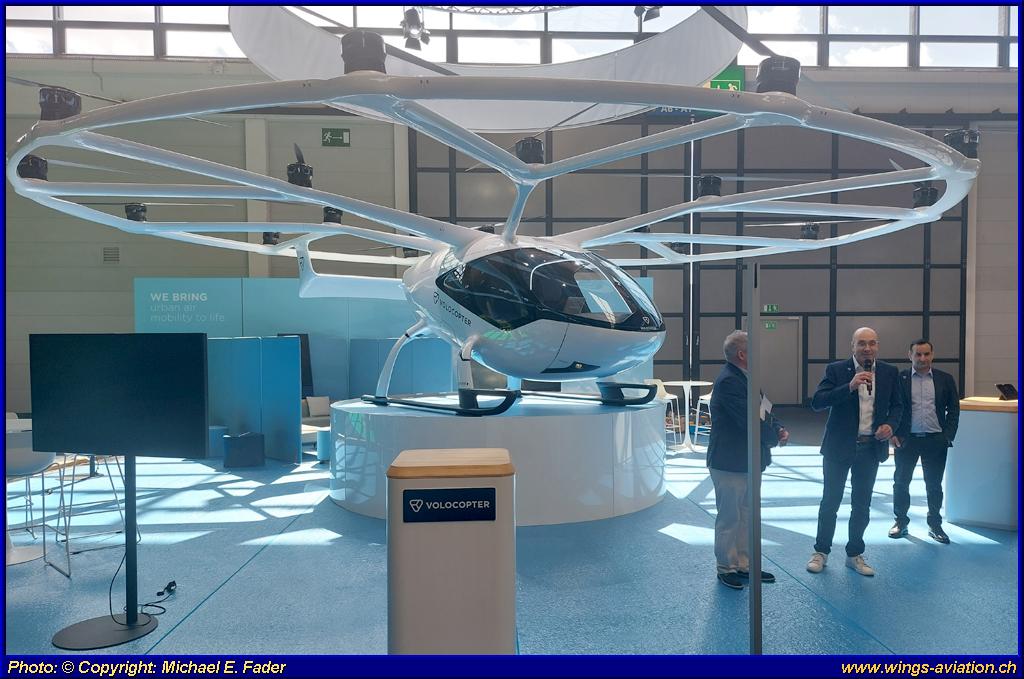


Volocopter (Picture courtesy Michael E. Fader)
Volocopter (Picture courtesy Michael E. Fader)
EVOcopter (Picture courtesy Michael E. Fader)
EVOcopter (Picture courtesy Michael E. Fader)
EVOcopter (Picture courtesy Michael E. Fader)
Kälin Aero
Kälin Aero, based in Oberndorf-Hochmössingen, unveiled its latest model, the B-100C. The B-100C is a lightweight training aircraft; weighing just 600 kg, it is powered by a 130 hp Edge Performance engine that propels it to speeds of up to 341 km/h. With the B-100C, Kälin Aero aims to enter the highly competitive market for training aircraft. It remains to be seen whether this lightweight design concept will prove successful.


Kaelin B-100C (Picture courtesy Michael E. Fader)
Kaelin B-100C (Picture courtesy Michael E. Fader)
Kaelin B-100C (Picture courtesy Michael E. Fader)
Kaelin B-100C (Picture courtesy Michael E. Fader)
Kaelin B-100C (Picture courtesy Michael E. Fader)
Daher & TBM
Daher and Rheinland Air Service are showcasing two new aircraft at a joint stand. Daher presented the Kodiak 900, an extended and optimised version of the Quest Kodiak 100. It is approximately 1.10 metres longer and features a fixed cargo compartment located beneath the fuselage. The aircraft is also powered by a more powerful PT6A turboprop engine, which increases the maximum speed to 210 knots. The Daher Kodiak 900 is specifically designed for multi-purpose operations.
The TBM 980 marks the latest addition to the successful TBM aircraft family. The TBM 980 is equipped with a touchscreen-controlled cockpit. In the cabin, the six seats feature USB-C ports and a Starlink connection is available.


Daher Kodiak 900 (Picture courtesy Michael E. Fader)
Daher Kodiak 900 (Picture courtesy Michael E. Fader)
Daher Kodiak 900 (Picture courtesy Michael E. Fader)


Daher Kodiak 900 (Picture courtesy Michael E. Fader)
TBM 980 (Picture courtesy Michael E. Fader)
TBM 980 (Picture courtesy Michael E. Fader)
Daher Kodiak 900 (Picture courtesy Michael E. Fader)
Daher Kodiak 900 (Picture courtesy Michael E. Fader)
Junkers
 The
history of JUNKERS Aircraft stretches back over a century and was
significantly shaped by Professor Hugo Junkers (1859–1935). His
revolutionary patents set new standards in 20th-century aviation.
Today’s JUNKERS Aircraft GmbH continues this tradition, combining
historic engineering expertise with state-of-the-art technology. JUNKERS
Aircraft GmbH, based in Oberndorf-Hochmössingen, exhibited three models
at AERO in Friedrichshafen.
The
history of JUNKERS Aircraft stretches back over a century and was
significantly shaped by Professor Hugo Junkers (1859–1935). His
revolutionary patents set new standards in 20th-century aviation.
Today’s JUNKERS Aircraft GmbH continues this tradition, combining
historic engineering expertise with state-of-the-art technology. JUNKERS
Aircraft GmbH, based in Oberndorf-Hochmössingen, exhibited three models
at AERO in Friedrichshafen.
The JUNKERS A50 Junior is a 600 kg ultralight aircraft, inspired by the historic model from 1929. As a modern low-wing aircraft, it combines classic design with the latest technology. It comes as standard with a Rotax 912iS four-cylinder fuel-injected engine (100 hp) and a two-blade wooden propeller.
The JUNKERS A50 Heritage is a reconstruction of the historic 1920s model, closely based on the original. Unlike the A50 Junior, the Heritage version is powered by a seven-cylinder radial engine (Verner Scarlett 7U, 124 hp). Combined with a wooden propeller and analogue round instruments, it offers an authentic retro flying experience. The pilot and passenger sit in a tandem configuration in the A50 Heritage.
The JUNKERS A60 is a modern evolution of the A50 Junior. It features a fixed tricycle landing gear and side-by-side seating, ensuring a high level of comfort and an enhanced flying experience. The enclosed canopy offers additional protection; the A60 is also available as a convertible and can be flown with the canopy open or closed. As demonstrated at the exhibition, switching from one configuration to the other takes just a few minutes.
The interior, inspired by luxury sports cars, combines elegance with high-quality materials. The A60 comes as standard with Garmin avionics, Beringer brakes and a Galaxy emergency system. It is powered by a 130 hp Edge Performance engine. At the media day on 21 April 2026, a representative of the DULV (German Ultralight Flying Association) presented the manufacturer with the type certificate for its latest model, the JUNKERS A60.
In the summer of 2025, JUNKERS opened a new facility at Giovanni Nicelli Airfield (Venice-Lido) in Italy. Almost 100 years after the first commercial flights with JUNKERS aircraft in Italy, the brand is thus returning to this historic location,” says Dieter Morszeck, the founder of Junkers Aircraft and one of the two managing directors. Italy is one of the most important markets for JUNKERS and plays a key role in the company’s European expansion.


(Picture courtesy Michael E. Fader)
Junkers A50 Junior (Picture courtesy Michael E. Fader)
Junkers A50 Junior (Picture courtesy Michael E. Fader)
Junkers A50 Junior (Picture courtesy JUNKES Aircraft GmbH)
Junkers A50 Heritage (Picture courtesy Michael E. Fader)


Junkers A50 Heritage (Picture courtesy Michael E. Fader)
Junkers A50 Heritage (Picture courtesy JUNKERS Aircraft GmbH
Junkers A50 Heritage (Picture courtesy Michael E. Fader)
(Picture courtesy Michael E. Fader)
Junkers A60 (Picture courtesy Michael E. Fader)


Junkers A60 (Picture courtesy JUNKERS Aircraft GmbH)
Junkers A60 (Picture courtesy JUNKERS Aircraft GmbH)
Junkers A60 (Picture courtesy JUNKERS Aircraft GmbH)
Junkers A60 (Picture courtesy Michael E. Fader)
Junkers A60 (Picture courtesy Michael E. Fader)
With around 37,000 visitors from 88 countries, the 32nd edition of Aero can be considered a success.


